Showing posts with label location: Italy. Show all posts

28 May 2008

Sunset over the Arno

I finally got around to processing all the rest of my Florence photographs from September 2007. Here's one of sunset over the Arno River. You can view the whole album here. I always like to put a sunset shot last in my slide shows, if I've got a good one.

17 November 2007

[Italy trip] Prayer

Old monk praying during the Vesper service at San Miniato al Monte, in Florence.

20 October 2007

[Italy trip] Conventional conventical technology

I liked this wooden cart which I saw on the grounds of Villa Agape where we stayed in Florence, which is run by the Sisters of "Stabilite nella Carità" (stability in charity). Simple technology, elegant and rustic at the same time. Interesting shapes and textures. I did quite a bit of Photoshopping on this, as there were some distracting blotches of lighter color on the handle near the rusty metal joint which immediately drew one's focus and ruined the composition (in my opinion). I think I did a pretty good job of cloning the wood grain where those spots had been, in a way that doesn't look faked. This is Photoshop at its best -- used to fix something which was not a photographer's error, yet without violating the true nature of the original subject. (That gives a lot of latitude, by the way, to adjust colors, etc. And there is always validity in creatively changing the subject. So don't quote that line back at me if you see something more wild in my use of Photoshop in the future.)

13 October 2007

Destroying restored art vs. restoring destroyed art

More reflections from my art tour of Florence. This 14th or 15th century fresco in San Miniato al Monte (Florence) looks like it has probably had some restoration work done on it over the years, as its colors are so well preserved (I have not touched them up in Photoshop). But also preserved for all eternity (until someone decides to do another restoration on it) are the graffiti of some 20th century vandals (in the lower right corner, on the red patches; click to zoom in on image). It appals me that anybody could be so philistine as to ruin art in a sacred space like this. Fortunately, at not very great expense (certainly not like what it would cost to repair the actual fresco), I can fix the damage pretty well in Photoshop. This illustrates the non-destructive restoration possible in digital media. I can keep a copy of the original, just in case someone doesn't like the kind of touching up I did.

Not so with non-digital art. Case in point: the famous Crucifix by Cimabue, painted to hang above the altar in Santa Croce in Florence. It had been lingering in storage, leaning up against a wall in the refectory, after renovations had replaced it with some other piece. Then it was almost completely destroyed in the great 1966 flood of the Arno River. The controversial restoration by Umberto Baldini used a new technique in which areas where the paint had been completely washed off are approximated with a pixel pattern that only suggests the color and outline of what was there before, but does not recreate brush strokes. Baldini and his team "felt strongly that it was inappropriate to leave this extremely important work as a mere fragment, and yet they were unwilling to deceive the viewer into thinking that the work was undamaged. Chromatic abstraction was their answer to this dilemma. Chromatic abstraction is formulated on the idea that three dominant tones can be abstracted from any painting. These colors, combined in the losses in small strokes that follow the dynamic flow of the image, and in the correct proportions, create the neutral color that blends most perfectly with the painting, making the losses the least distracting without inpainting them imitatively." (Getty Conservation Institute, Painted Wood: History and Conservation, p. 414.) You can see this clearly in the detail of Christ's feet (below, right; click to zoom in on image). Some people have objected to Baldini's restoration because it is not Cimabue's work at all. They claim that the ravages of time and natural disasters are part of the history of art that should be preserved. I am still undecided on this issue. I can't say I liked the restored Crucifix. But it is intriguing from an art historical point of view. You can read more about the restoration debate in this article, and (if you have JSTOR access) in "Art and Its Preservation" by David Carrier (Journal of Aesthetics and Art Criticism 43:3 (Spring 1985), pp. 291-300).

With digital art (including digital photography), all of this is moot. The original cannot become degraded over time, or destroyed by a flood or fire, nor can it be vandalized, as long as a backup is made. And as long as it is converted to new media as they are invented and the old ones become obsolete! That latter would be a subject for "a whole 'nother" post (my favorite example of tmesis, a figure of speech in which a word or phrase is inserted into another word, often for humorous effect).

11 October 2007

The golden lampstand

[News flash: This photo of mine has been published online in Comment Magazine. Click here.]

"Aaron is responsible for keeping the lamps burning continually on the Lampstand of pure gold before GOD." (Lev 24:4; The Message)

Here is another in my votive candles series (see also this one). It is a portrait of a serious man of God, at work in the house of the Lord. This is one of the monks at San Miniato al Monte in Florence, lighting additional candles before the Vespers service. I was drawn to the glow on his face, and only later noticed the subtle outline highlight on his hair from a bit of sun coming in the window above his head. Without that, his head would have blended into the dark background. I considered whether to crop more of the black space at the bottom, but I decided to keep it, to emphasize the height of his body. You can see his robe disappearing into darkness and can imagine where it extends to.

Another possible composition crops it in way close and reveals the time on his watch (even though I was standing about 30 feet away from him; see, there is a use for 12.8 megapixels!) -- the Vespers service did indeed start at 5:30pm. You'll need to click to view the image at full size to be able to read it. For you techies who are interested, this was shot with a 70mm lens, ISO 1600, f/4 at 1/125. Hand held, no flash. ISO 1600 on my Canon 5D rocks! It was very dark in there. I'm beginning to think I like this second one better. What do you think?

05 October 2007

Where is the frame of this picture?

Frame-within-a-frame is a motif that shows up in all kinds of art, from René Magritte to Norman Rockwell to Alfred Hitchcock's films to the Frame Within a Frame group at Flickr. I visited Siena for a day and took lots of photos of all the beautiful architecture and art, just for my own memory. Boring. Well, you might want to see them and they might cause you extreme envy, but I can't claim they are my own artistic creations. However, when I deviated from the usual touristic camera behavior and started looking for the offbeat and quirky, which I guess is where my forte lies, I found this fun subject walking right across my field of view. I like it because though I've chosen to frame it in a certain way, the frame the man is holding makes its own declaration about what is the subject of the picture -- the man's legs and the bag of the lady behind him. Because he's holding two frames (which, incidentally, make a nice repeated shape), the people on either side of him got that experience (though I with my camera could only see one of those views).

27 September 2007

Back from Italy

I have over 1600 photos to sort through to select the best ones to show, and that's going to take some time, but here's a start. This one I've titled "The Art Critics." As would be expected from a trip to Italy which focused on visiting family and taking a seminar in Florence called "Art and Cultural Transformation in the Renaissance," a lot of my photos are portraits or group candids of family members, reproductions of art, and documentary travel photos, not many of which would be worth sharing on this blog (however I will be putting together an online photo album of a selection of my trip photos to show friends and family who are interested in seeing them and will announce its availability here). But there are a few when I was consciously trying to make art myself instead of just looking at it, and those (when successful) I'll be showcasing here over the coming days or weeks.

Sometimes more interesting photographs come from photographing not the "main attraction" (e.g., the art in a museum or cathedral) but rather something you see when you turn around and look at what's going on behind you or next to the central event. My favorite example of this is Ed Clark's famous photo in Life Magazine of Navy CPO Graham Jackson playing the accordion at FDR's funeral. That's much more powerful than a photo of what everyone else in the audience was looking at: a casket rolling by. I try to remember that principle whenever I'm somewhere with a viewing audience. (Hmm, "viewing audience" sounds oxymoronic. Do we have a word in English that means "a group of people viewing a spectacle or work of art together" which isn't derived from a root meaning "to hear"?)

So in this case, I wasn't even interested in reproducing the entire work of art. It happens to be "Deposizione dalla croce" (Deposition from the Cross) by Francesco Salviati, a lovely work by a painter I'd never heard of, but for the purposes of my photograph, who cares? That isn't the point. The point is how intently people look at art when they think they know something about it or want to discuss their reactions to it with each other. It's also about how, when you look away from the main subject, you often see something interesting. In this case, in addition to focusing on the viewers rather than the full painting, I've captured a part of the painting in which the painter represented one of the onlookers to the "main attraction" (a significant one, mind you, so it partly defeats my purpose; she's Mary, the mother of Jesus, whose body being taken down from the cross is the "main attraction" in the painting). With my weird sense of humor and taste for comical juxtapositions, I also like the amusing fact that the guy on the right is sort of making an unintentional obscene gesture at us (the photographer and viewers) who are looking over his shoulder at a sacred painting. (You might have to click on the photo to see a bigger version of it to be able to tell.)

23 August 2007

Italy bound!

Portofino, ItalySorry once again for the long hiatus, but it's for good reason. I've been on vacation in Vermont with my family, and getting ready for my month-long trip to Italy. Lots of photography inspiration there, and I'm going loaded up with 80 gigabytes of portable hard disk space for images. My tentative itinerary includes Lake Como, Santa Margherita, Cinque Terre, Lucca, Florence, Follonica, and Rome. In Rome I've signed up for a Roman Cuisine tour which begins with a walking tour of the Testaccio quarter -- "the heart of traditional Roman gastronomy and a pilgrimage destination for food-lovers everywhere" -- where we'll shop for fresh ingredients, and concludes with a cooking lesson and meal with wine at the home of the guide/teacher.Market in Genoa

Here are three of my shots from last summer to whet your appetite for what is to come. The first (above) is of Portofino. The second is a market in Genoa. Last (below) is the great key unlocking the door of the cellar at the Azienda Agricola Carlotta e Rivarola winery run by the friend of a cousin of mine. The photo reminds me of a quote by John Bunyan from Pilgrim's Progress (the original language version): "Then Christian pulled it [the Key] out of his bosom, and began to try at the Dungeon door, whose bolt That lock went damnable hard.(as he turned the Key) gave back, and the door flew open with ease, and Christian and Hopeful both came out. Then he went to the outward door that leads into the Castle-yard, and with his Key opened that door also. After he went to the iron Gate, for that must be opened too, but that Lock went damnable hard, yet the Key did open it."

You'll have to come back at the end of September to see more.

13 June 2007

Being "in the zone"

I read an interesting post on creativity today on Doug Stockdale's Singular Images blog. Some key excerpts:

…from Octave of Prayer, Minor White wrote “Intensified concentration is common to all creative people…philosphers name this concentration Creativity; the devout call it Meditation”.
…
[H]e describes different ways of artists getting into what I call the ”zone”. Time seems to drift. There is an intensity to the moment as the concentration seems to increase almost on its own. You seem to flow effortlessly.
…
I remember an old adage; try to make at least one exposure within the first 15 minutes of arriving at the area you are interesting in photographing. Now I understand that this is a methodology to engage me and my vision, increase my concentration and make a quicker transition in to the “zone”.

I long for that experience. I'm not sure I've ever had it, or if I have, it has been so long that I've forgotten it. I usually have no problem making an exposure within the first 15 minutes, but I think I usually make one too quickly, without taking the time to size up my surroundings and engage in meditation. Thus I usually get tired of an area quickly and move on, or stop shooting. That's not entirely true when I'm somewhere that totally takes my breath away. But I think that's different than being "in the zone" as Doug describes. When rapt by the sheer beauty of a place, I sometimes don't even think about the process of creating my art. I also do it too quickly, since I'm more interested in simply absorbing the experience of being in that place. Not that that is a bad thing, mind you. If I were incapable of appreciating beauty except by making art about it, I'd be impoverished as a human being, I think.

It seems to me that being "in the zone" can be independent of the level of ordinariness or beauty of the subject being photographed, however due to the spiritual atrophy most of us suffer from, we usually need beauty to kickstart the experience.
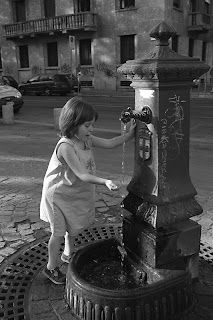
One experience I can remember that comes closest to being "in the zone" was when I was visiting some relatives in Italy and I accompanied a cousin and her granddaughter to the playground. As we were walking home, I saw the little girl catch a glimpse of a water fountain up ahead and run towards it gleefully. The lighting was perfect, my camera was in hand, and I was alert to the moment. I ran ahead of her and reached the fountain before she did. When she got there, I just started shooting, enjoying watching her delight in how the water felt on her hands, recalling a lost childhood of my own, etc. It was positively magical. This all happened in a matter of seconds, perhaps a minute and a half at most. Here is the prize photo that came out of that.

I have just discovered Picasa Web Albums. A great way to share a series of photos from a trip if you just want to upload them and not bother with blog commentary. Free, easy to publish with, and the nicest viewer UI of any web album product I've seen yet. All you need is a Google account, which all of us Blogger users have anyway. In fact, if you have a blog on Blogger, when you sign up on the Picasa website, it automatically makes an album of all the photos you have posted in your blog, and keeps adding new ones automatically as you post more to your blog. However, it seems to put them in random order initially (though you can reorder them however you like afterwards), and it only goes back so far. In my case, 83 photos, back to December 2006.


Photography Directory by PhotoLinks